Create image embeddings with Huggingface
We use the Huggingface transformers library to create an embedding for a an image dataset.
Use Chrome to run Spotlight in Colab. Due to Colab restrictions (e.g. no websocket support), the performance is limited. Run the notebook locally for the full Spotlight experience.
df['image']contains the paths to the images in the dataset
df['embeddings']contain the image embeddings for each data sample
modelnamedesignates the pre-trained model used to compute the embedding. You can find more than 200k available models on the Huggingface model hub.batchedis a boolean variable that designates if the embedding computation is performed in batch mode.batch_sizedesignates the batch size for the computation.
Imports and play as copy-n-paste functions
# Install dependencies
# Imports
!pip install renumics-spotlight transformers torch datasets
# Play as copy-n-paste functions
import datasets
from transformers import AutoFeatureExtractor, AutoModel
import torch
from renumics import spotlight
import pandas as pd

def extract_embeddings(model, feature_extractor, image_name='image'):
    """Utility to compute embeddings."""
    device = model.device

    def pp(batch):
        images = batch["image"]
        inputs = feature_extractor(images=images, return_tensors="pt").to(device)
        embeddings = model(**inputs).last_hidden_state[:, 0].cpu()

        return {"embedding": embeddings}

    return pp

def huggingface_embedding(df, image_name='image', inplace=False, modelname='google/vit-base-patch16-224', batched=True, batch_size=24):
    # initialize huggingface model
    feature_extractor = AutoFeatureExtractor.from_pretrained(modelname)
    model = AutoModel.from_pretrained(modelname, output_hidden_states=True)

    # create huggingface dataset from df
    dataset = datasets.Dataset.from_pandas(df).cast_column(image_name, datasets.Image())

    #compute embedding
    device = "cuda" if torch.cuda.is_available() else "cpu"
    extract_fn = extract_embeddings( model.to(device), feature_extractor,image_name)
    updated_dataset = dataset.map(extract_fn, batched=batched, batch_size=batch_size)

    df_temp = updated_dataset.to_pandas()

    if inplace:
        df['embedding']=df_temp['embedding']
        return

    df_emb = pd.DataFrame()
    df_emb['embedding'] = df_temp['embedding']

    return df_emb
Step-by-step example on CIFAR-100
Load CIFAR-100 from Huggingface hub and convert it to Pandas dataframe
dataset = datasets.load_dataset("renumics/cifar100-enriched", split="train")
df = dataset.to_pandas()
Compute embedding with vision transformer from Huggingface
df_emb = huggingface_embedding(df, modelname="google/vit-base-patch16-224")
df = pd.concat([df, df_emb], axis=1)
Reduce embeddings for faster visualization
import umap
import numpy as np
embeddings = np.stack(df['embedding'].to_numpy())
reducer = umap.UMAP()
reduced_embedding = reducer.fit_transform(embeddings)
df['embedding_reduced'] = np.array(reduced_embedding).tolist()
Perform EDA with Spotlight
df_show = df.drop(columns=['embedding', 'probabilities'])
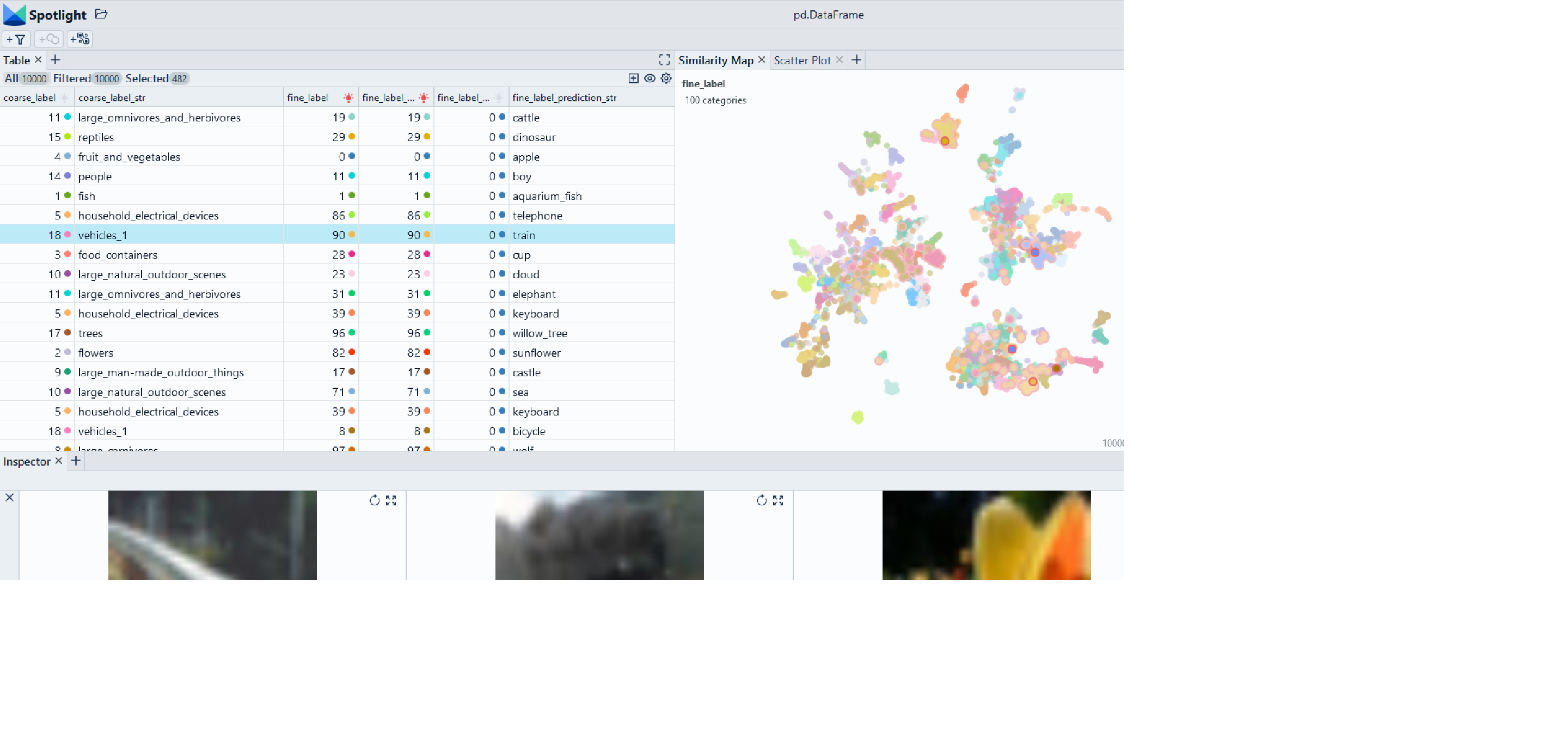
spotlight.show(df_show, port=port, dtype={"image": spotlight.Image, "embedding_reduced": spotlight.Embedding})